In the past decade, businesses focused mainly on SEO (Search Engine Optimization) to rank higher on Google and other search engines. But now, the digital landscape is changing rapidly. With the rise of AI-powered tools like ChatGPT, Google Gemini, and AI-generated search summaries, a new strategy is emerging — GEO (Generative Engine Optimization).
If you want your website, blog, or business to stay competitive in 2026 and beyond, understanding and implementing GEO is essential.
This complete guide will explain:
- What GEO is
- How GEO is different from SEO
- Why GEO is important
- Step-by-step GEO implementation strategy
- Tools you can use
- Common mistakes to avoid
- FAQs about GEO
Let’s get started.
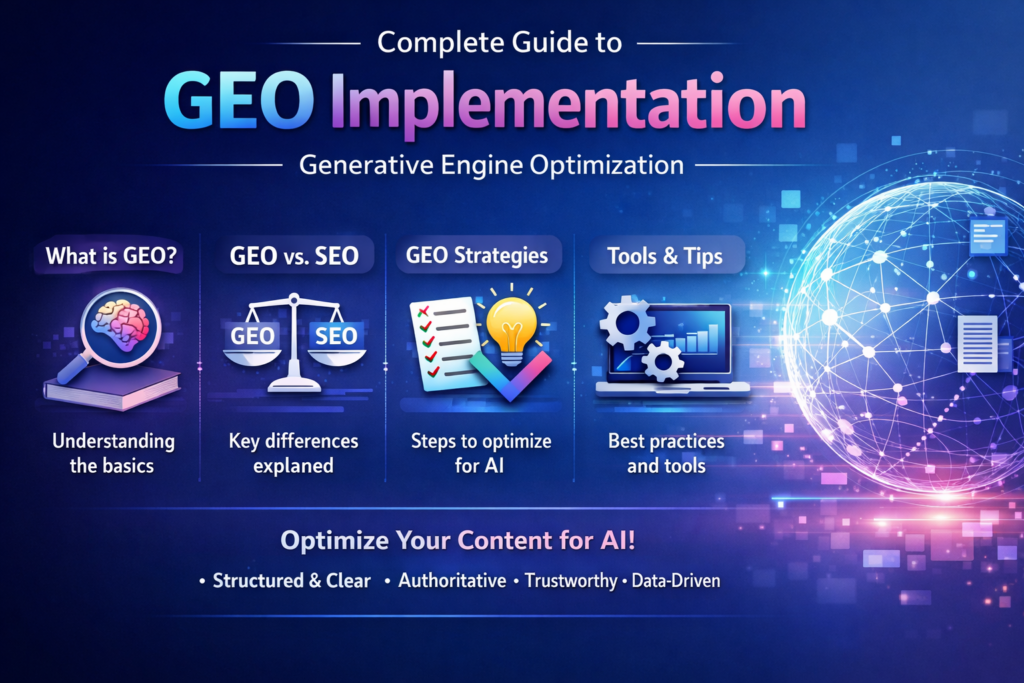
What is GEO (Generative Engine Optimization)?
Generative Engine Optimization (GEO) is the process of optimizing your content so that AI-powered search engines and generative tools can understand, reference, and recommend your website in their answers.
Traditional SEO focuses on ranking web pages on search engine result pages (SERPs).
GEO focuses on making your content:
- Easy for AI models to understand
- Structured for AI summaries
- Citable in AI-generated responses
- Trustworthy and authoritative
In simple words: SEO helps you rank on Google. GEO helps you get mentioned by AI.
What Are Generative Engines?
Generative engines are AI-powered systems that provide direct answers instead of just listing links.
Examples include:
These tools analyze large datasets and generate summarized answers for users.
If your content is optimized for GEO, these platforms may:
- Cite your website
- Summarize your content
- Recommend your brand
- Use your data as a trusted source
Why GEO is Important in 2026
Here are key reasons why GEO matters:
1. AI Is Changing Search Behavior
Users now ask full questions like:
- “What is the best way to implement GEO?”
- “Explain blockchain in simple terms.”
AI tools give direct answers — users may not even click links.
2. Zero-Click Searches Are Increasing
Google’s AI Overviews and answer boxes reduce clicks to websites.
If your site is referenced in AI responses, your visibility increases even without traditional ranking.
3. Brand Authority Matters More
Generative engines prefer:
- Trusted domains
- Well-structured content
- Expert-backed information
This makes GEO a long-term branding strategy.
GEO vs SEO: Key Differences
| SEO | GEO |
|---|---|
| Focuses on ranking | Focuses on AI citation |
| Keyword-based | Intent-based |
| Backlink-heavy | Authority + clarity |
| Meta optimization | Structured clarity |
| CTR driven | Trust driven |
You still need SEO — but GEO adds a new layer.
Step-by-Step Guide to GEO Implementation
Now let’s move to the practical part.
Step 1: Create Clear, Structured Content
AI prefers content that is:
- Organized with headings (H1, H2, H3)
- Written in simple language
- Direct and factual
- Answer-based
Best Practice:
Use this structure:
- Definition
- Explanation
- Steps
- Examples
- Summary
- FAQs
Avoid unnecessary fluff.
Step 2: Focus on Search Intent, Not Just Keywords
Instead of stuffing keywords, answer:
- What?
- Why?
- How?
- When?
- Who?
For example:
Bad:
GEO implementation strategy best guide SEO GEO AI optimization.
Good:
Generative Engine Optimization (GEO) helps your website get cited by AI-powered search tools like ChatGPT and Google Gemini.
Step 3: Add Data, Statistics, and Examples
AI tools prefer content with:
- Numbers
- Case studies
- Research
- Clear examples
Example:
Instead of saying “GEO is growing,” say:
AI-driven search usage increased significantly in recent years, with millions of users relying on AI-generated summaries daily.
Step 4: Build Topical Authority
Create content clusters.
For example:
Main Topic:
- GEO Implementation Guide
Supporting Articles:
- What is Generative Engine Optimization?
- GEO vs SEO
- How AI Search Works
- Best Tools for GEO
Interlink all pages properly. This helps AI understand your site expertise.
Step 5: Use Structured Data (Schema Markup)
Add schema markup like:
- FAQ schema
- Article schema
- How-to schema
- Organization schema
Schema helps AI and search engines understand context.
Step 6: Improve E-E-A-T Signals
E-E-A-T stands for:
- Experience
- Expertise
- Authoritativeness
- Trustworthiness
To improve E-E-A-T:
- Add author bio
- Show credentials
- Link to reliable sources
- Add contact information
- Use HTTPS
AI engines prefer trusted websites.
Step 7: Optimize for Conversational Queries
AI engines respond to natural language questions.
Include sections like:
- “What is…”
- “How does…”
- “Why is…”
Write as if you’re answering a student.
Step 8: Improve Technical SEO
Even for GEO, technical factors matter:
- Fast loading speed
- Mobile-friendly design
- Clean HTML structure
- Proper heading hierarchy
- Internal linking
AI systems crawl websites similarly to search engines.
Step 9: Publish Evergreen Content
AI prefers:
- Updated information
- Timeless guides
- Clear definitions
Update your content regularly.
Add:
Last Updated: Month Year
Step 10: Build High-Quality Backlinks
Even in GEO, backlinks help establish authority.
Focus on:
- Guest posting
- Niche-relevant links
- Editorial mentions
- PR coverage
Quality over quantity.
Tools for GEO Implementation
Here are useful tools:
- Google Search Console – Monitor impressions
- Ahrefs – Backlink analysis
- SEMrush – Keyword & authority research
- Screaming Frog SEO Spider – Technical SEO audit
Use these tools to strengthen SEO foundation for GEO success.
Common GEO Mistakes to Avoid
- Writing robotic content:
Robotic content sounds unnatural and is written only for search engines instead of real users. AI systems and readers prefer content that feels human, clear, and helpful. - Overusing keywords:
Using the same keyword again and again makes content look spammy. It reduces readability and can lower trust from both users and AI systems. - Ignoring user intent:
If your content does not answer what the user is actually looking for, it will fail to perform. Understanding the user’s intent helps AI engines select your content as a relevant answer. - Publishing thin content:
Thin content provides very little value and lacks proper explanation or depth. AI tools usually ignore such content because it does not fully answer user questions. - No author credibility:
Content without author information looks untrustworthy. Adding author details helps AI and users understand that the content is written by a knowledgeable person. - Not updating old articles:
Outdated content can contain incorrect or irrelevant information. Regular updates show that your website is active and reliable. - Poor internal linking:
Poor internal linking makes it difficult for AI and search engines to understand your site structure. Proper internal links improve navigation and help distribute authority across pages.
Remember: AI favors clarity and trust.
Future of GEO
In the coming years:
- AI answers will dominate search.
- Brand authority will matter more than keywords.
- Websites that provide structured, helpful content will win.
GEO is not replacing SEO — it is enhancing it.
GEO Implementation Checklist
✔ Clear headings
✔ Answer-based structure
✔ FAQ section
✔ Internal links
✔ Schema markup
✔ Author bio
✔ Updated content
✔ Fast website
✔ Authority backlinks
Frequently Asked Questions (FAQs)
1. What is GEO in digital marketing?
GEO (Generative Engine Optimization) is the process of optimizing content so AI-powered tools can understand, summarize, and cite your website in generated responses.
2. Is GEO replacing SEO?
No. GEO complements SEO. SEO helps you rank in search engines, while GEO helps AI tools reference your content.
3. How long does GEO implementation take?
It depends on your website size and authority. Results may take a few months, especially as AI systems update their training and indexing patterns.
3. Do backlinks matter in GEO?
Yes. Backlinks help build authority, which increases the chances of AI engines trusting and citing your content.
4. How do I know if AI tools are citing my content?
You can manually check by asking AI tools questions related to your niche and seeing whether your site is referenced.
5. Is schema markup important for GEO?
Yes. Schema helps AI systems understand the context of your content better.
6. Can small websites benefit from GEO?
Absolutely. If content is well-structured, helpful, and authoritative, even smaller websites can gain AI visibility.
Final Thoughts
Generative Engine Optimization (GEO) is the next evolution of digital visibility. As AI tools like ChatGPT and Google Gemini reshape how people search for information, businesses must adapt.
The key to successful GEO implementation is:
- Clear structure
- Trustworthy content
- Strong authority
- User-focused writing
Start implementing GEO today — because the future of search is generative.

Reach me through WhatsApp: +91-7838150833
- 100+ Promise Day Ideas to Make Your Love Stronger (Romantic, Cute & Meaningful) - February 11, 2026
- Complete Guide to GEO Implementation (Generative Engine Optimization) - February 11, 2026
- A Small Travel Moment: Coffee, Calm, and a Quiet Hotel Lobby - December 12, 2025
Related posts:
 How To Get More Subscribers On YouTube
 Tricks To Rank YouTube Videos
 Top 5 Keyword Research Tools For SEO In 2019
 Top 5 Blogging Platforms for your blog in 2019
 Guide To Create a Sitemap For WordPress Blog
How Google shows search results to users
Guide To Create a Sitemap For WordPress Blog
How Google shows search results to users
 How Can We Use AI In Digital Marketing?
 Video Content vs Written Content: Benefits of video content over written content